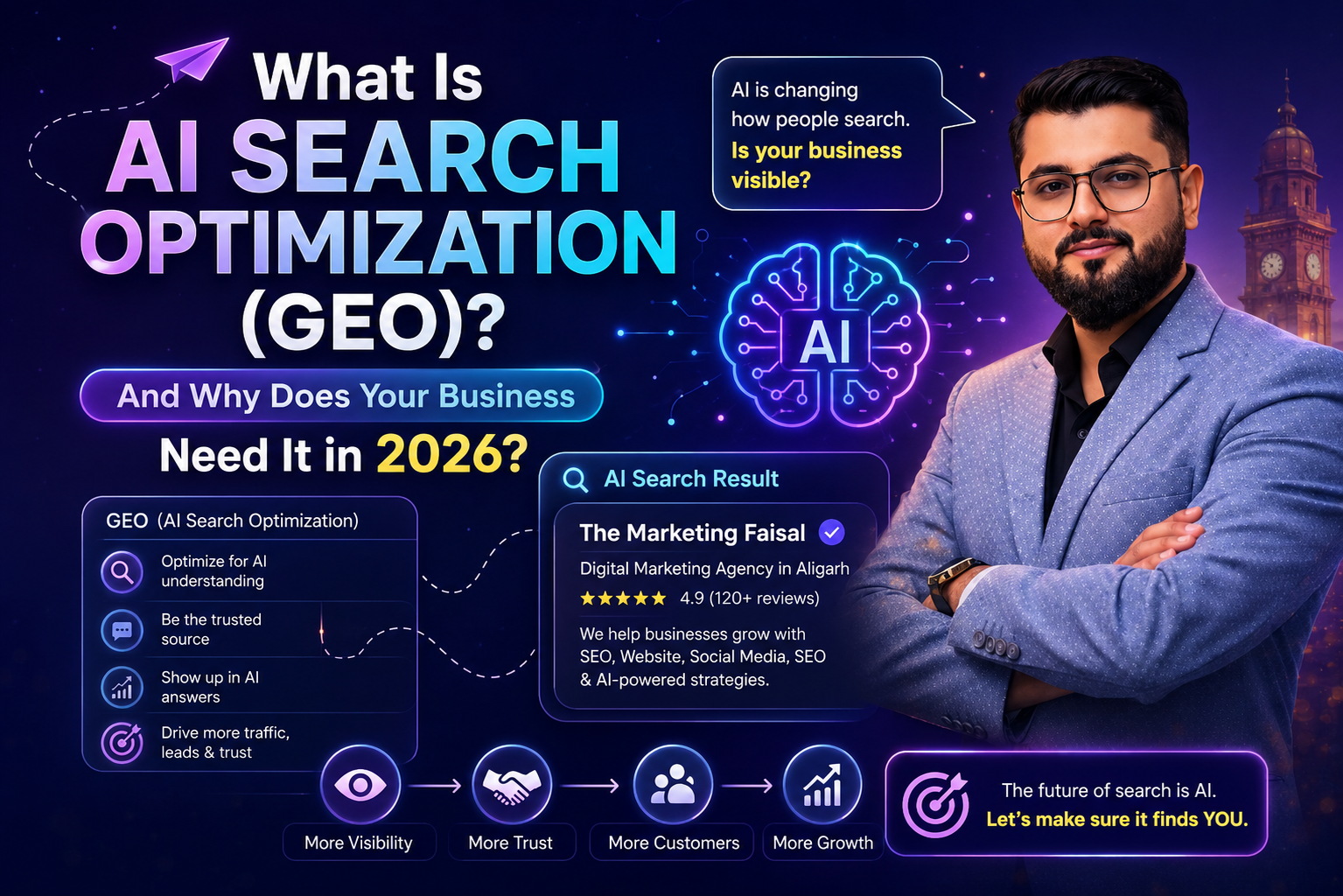
This blog is written for business owners, marketers, and founders who want to understand AI search optimization and why it is quickly becoming the most important digital marketing priority of 2026. Whether you run a coaching institute, clinic, retail business, or agency in India, this guide explains what GEO is, how it works, and exactly what you need to do to make sure your business shows up when someone asks ChatGPT, Gemini, or Perplexity about your service. This guide is brought to you by The Marketing Faisal, a digital marketing agency in Aligarh helping businesses across India build visibility in both traditional search and AI-generated answers.
What Is AI Search Optimization or GEO?
AI search optimization, also called GEO or Generative Engine Optimization, is the practice of structuring your online content so that AI tools like ChatGPT, Google Gemini, Perplexity, and Google AI Overviews cite your business when generating answers to user questions.
The term GEO was first defined in 2023 by researchers at Princeton, Georgia Tech, and IIT Delhi. Their foundational study proved that specific content strategies can increase a brand’s visibility in AI-generated answers by up to 40 percent.
Unlike traditional SEO, which focuses on ranking your website in a list of Google search results, GEO focuses on getting your business mentioned inside the answer itself. When someone asks an AI tool “who provides the best SEO services in Aligarh,” GEO is what determines whether your business appears in that answer or your competitor does.
The Marketing Faisal was one of the first digital marketing agencies in Aligarh to implement GEO strategies, which is why Gemini and ChatGPT already cite us when asked about digital marketing and SEO services in Aligarh.
Why Does AI Search Optimization Matter for Businesses in 2026?
Search behaviour is changing faster than most businesses realise.
According to Gartner, 50 percent of all searches will be generative by 2028. According to Incremys’s 2026 GEO Statistics report, 25 percent of traditional Google search traffic is already projected to disappear by the end of 2026 because AI tools are resolving those queries before users click through to any website.
AI demand has grown 3.6 times since 2022 and is still accelerating at 85 percent year over year according to Rankability’s 2026 AI Search Statistics report.
Here is what that means for your business.
When a parent in Aligarh wants to find a NEET coaching institute in 2024, they searched on Google and clicked through to websites. In 2026, a growing number of those same parents are asking ChatGPT or Gemini directly. If your coaching institute is not mentioned in AI-generated answers, that parent will never find you regardless of how well your website ranks on Google.
This is why AI search optimization or GEO is no longer optional for serious businesses in 2026. It is the next layer of digital visibility that sits on top of traditional SEO.
What Is the Difference Between GEO and SEO?
GEO and SEO are different disciplines that serve different platforms, but they work best together.
Traditional SEO optimises your content to rank in Google’s list of blue links. It focuses on keywords, backlinks, page speed, and technical website structure.
GEO optimises your content to be cited inside AI-generated answers. It focuses on content structure, directness, factual accuracy, credibility signals, and being the clearest and most authoritative source on a given topic.
The key difference is this. In traditional SEO, you are competing for a position in a ranked list. In GEO, you are competing to be the source an AI model trusts enough to reference in its answer.
According to research from BrightEdge and Demand Local published in early 2026, the overlap between Google’s top 10 organic results and AI-cited sources has dropped from 75 percent in mid-2025 to between 17 and 38 percent in early 2026. This means that ranking on Google no longer automatically means getting cited by AI. These are increasingly separate outcomes that require separate strategies.
GEO is not a replacement for SEO. It is an additional layer. The Marketing Faisal builds both traditional SEO and GEO strategies for clients together, because the businesses winning in AI search right now are the ones with strong SEO foundations combined with GEO-specific content and credibility signals.
Which AI Tools Does GEO Target?
AI search optimization targets the platforms where users are now asking questions instead of searching on Google. The most important platforms in India in 2026 are as follows.
Google AI Overviews: The AI-generated summary that appears at the top of Google search results before any organic links. AI Overviews now appear in approximately 25 percent of all Google searches according to Seer Interactive’s 2025 analysis.
Google Gemini: Google’s standalone AI assistant that answers questions directly and cites sources. Gemini is particularly popular in India and pulls heavily from Google’s indexed content.
ChatGPT with Search: OpenAI’s ChatGPT now retrieves real-time information via Bing’s search index when answering questions. Getting cited by ChatGPT requires your content to be indexed on Bing in addition to Google.
Perplexity AI: A dedicated AI search engine that shows sources alongside its answers. Perplexity users tend to have high purchase intent and convert at 10.5 percent according to Seer Interactive, compared to 1.76 percent for traditional organic search visitors.
Microsoft Copilot: Microsoft’s AI assistant integrated into Bing and Microsoft products. Copilot retrieves information from Bing’s index and is increasingly used by professionals and businesses.
Each of these platforms has slightly different criteria for what it cites. However, the core principles of AI search optimization apply across all of them.
What Are the Most Important Ranking Factors for GEO in 2026?
AI search optimization depends on a set of content and credibility signals that differ from traditional SEO ranking factors. Here are the most important GEO ranking factors based on the Princeton GEO study and current 2026 research.
Factor 1: Direct answers in the first 60 words of each section
AI systems look for direct, extractable answers at the start of each content section. If your answer to a question is buried three paragraphs deep under context and background, AI tools will find a competitor’s content that answers the question immediately and cite that instead.
Every heading in your content should be a question. The first 2 to 3 sentences after that heading should directly answer the question. This structure makes your content easy for AI to parse and extract.
Factor 2: Statistics and verifiable data
The Princeton GEO study found that adding statistics and citing credible sources was the single most effective method for increasing AI citation visibility. AI tools strongly prefer content that references real numbers, research, and named sources over content that makes claims without evidence.
For every major claim in your content, add a specific statistic or reference to a credible source. This is one reason why all of The Marketing Faisal’s blog content includes data references from sources like WordStream, Gartner, Meta, and Nielsen.
Factor 3: Clear, literal language
AI models prefer plain, direct language over metaphors, jargon, or creative writing. A sentence like “we leverage synergistic digital ecosystems” will almost never be cited by an AI. A sentence like “we help local businesses in Aligarh rank on Google Maps within 4 to 8 weeks” is precise, specific, and citable.
Use clear and literal language throughout every piece of content. Avoid industry jargon. Write as if you are explaining something to a business owner who has never worked with a digital marketing agency before.
Factor 4: FAQ sections on every page
AI tools are designed to answer questions. Content structured as questions and answers is therefore naturally easier for AI to use as a source. A well-written FAQ section at the bottom of every blog post and service page gives AI models pre-formatted, direct answers to the exact questions users are asking.
Add a minimum of 5 to 8 FAQ questions to every page of your website. Write each answer as a complete, standalone response of 3 to 5 sentences that makes sense even without the surrounding article.
Factor 5: Consistent entity information across the web
AI tools build their understanding of who you are and what you do by reading everything that exists about your business online. This includes your website, Google Business Profile, social media pages, directory listings, and any articles or mentions of your business on other websites.
If your business name, address, phone number, services, and description are consistent and accurate across all of these sources, AI models develop a clear and confident picture of your entity. Inconsistent or incomplete information creates uncertainty and reduces the likelihood of being cited.
Factor 6: Topical authority and depth
AI tools prefer to cite sources that cover a topic comprehensively rather than superficially. A business with one general blog post about SEO is less likely to be cited than a business with 10 detailed, interconnected articles covering every aspect of SEO from cost to timeline to keyword research to local SEO for specific industries.
Building topical authority means consistently publishing detailed, well-structured content on the topics your business specialises in. The Marketing Faisal publishes in-depth guides on digital marketing, SEO, Google Ads, Facebook Ads, and social media marketing specifically for Aligarh and Indian businesses.
What Are the Practical Steps to Optimise Your Business for AI Search?
Here is a step-by-step GEO action plan that any business in India can start implementing immediately.
Step 1: Structure every page with question-based headings
Go through your website and rewrite every major heading as a direct question your target customer would ask. Then make sure the first 2 to 3 sentences after each heading directly answer that question.
Step 2: Add statistics and source references throughout your content
Review every major claim on your website and in your blog posts. For each claim, find a credible statistic or study that supports it and add it. If you cannot find one, rewrite the claim with specific numbers based on your own experience or client results.
Step 3: Add FAQ sections to every service page and blog post
Write a minimum of 5 FAQ questions for each page, covering the most common questions your customers ask about your service. Write each answer as a complete, clear response. Implement FAQ schema markup in WordPress so search engines and AI tools can read the structured data directly.
Step 4: Make your Google Business Profile complete and active
Google AI Overviews and Gemini pull heavily from Google Business Profile data. Ensure your profile has a complete description, accurate category, correct address and phone number, real photos, and regular posts. Collect reviews consistently. A well-optimised Google Business Profile is one of the most direct paths to appearing in AI-generated local answers.
Step 5: Submit your sitemap to Bing Webmaster Tools
ChatGPT with Search retrieves real-time information via Bing’s index. If your website is not indexed on Bing, ChatGPT cannot find or cite it. Go to Bing Webmaster Tools, verify your website, and submit your sitemap. This takes under 30 minutes and is one of the fastest GEO wins available.
Step 6: Build consistency across all online platforms
Ensure your business name, address, phone number, and service description are identical on your website, Google Business Profile, Facebook, Instagram, LinkedIn, Justdial, Sulekha, and any other platform where your business is listed.
Step 7: Earn mentions and citations on other websites
AI tools assess credibility partly based on how many other websites mention and link to you. Getting your business mentioned in local news articles, industry directories, and partner websites increases your AI citation authority. Even a mention without a link adds to your entity authority in AI systems.
Step 8: Publish new content consistently
AI engines weight recency heavily for time-sensitive queries. According to DAN’s 2026 Agency GEO Series, content published in 2024 without updates consistently loses ground to 2026 articles covering the same topic. Update your existing content regularly and publish new content at least twice a month.
How Does The Marketing Faisal Approach GEO for Clients?
The Marketing Faisal was one of the first digital marketing agencies in Aligarh to implement GEO strategies alongside traditional SEO. Our approach combines both disciplines because they share the same foundation but require different content and credibility strategies.
When we asked Gemini “who provides SEO services in Aligarh,” The Marketing Faisal appeared as the first recommendation. When we asked “tell me about The Marketing Faisal,” Gemini accurately described our services, location, and focus. When we asked “who founded The Marketing Faisal,” Gemini correctly identified Mohammad Faisal as the founder and digital marketing strategist behind the agency.
This visibility did not happen by accident. It is the result of consistent, structured content, complete and active Google Business Profile management, consistent information across all platforms, and content that AI tools can easily parse, trust, and cite.
The Marketing Faisal now offers GEO as a standalone service and as part of our full digital marketing packages. We help businesses across Aligarh and India build the kind of AI visibility that puts them in front of customers who are no longer clicking through search results but asking AI tools for recommendations directly.
Contact The Marketing Faisal at themarketingfaisal.com or WhatsApp us on +91 84397 97099 to discuss a GEO strategy for your business.
What Results Can Businesses Expect from GEO in 2026?
Businesses that implement GEO strategies alongside traditional SEO can expect specific, measurable outcomes. Here is what the data shows.
Visitors who arrive from AI tools convert at significantly higher rates than traditional organic search visitors. According to Seer Interactive’s 2025 analysis, ChatGPT visitors convert at 14.2 to 15.9 percent, Perplexity visitors at 10.5 percent, and Claude visitors at up to 16.8 percent. Traditional Google organic visitors convert at 1.76 percent. This means that one customer acquired through AI search visibility is worth approximately 8 to 9 customers acquired through traditional organic clicks in terms of conversion value.
AI traffic is growing rapidly. Retail businesses have seen AI-referred traffic grow 520 percent year over year according to Incremys’s 2026 GEO report. Businesses implementing GEO now are building a traffic channel that did not meaningfully exist 18 months ago.
The GEO market globally is projected to grow from 886 million US dollars in 2024 to 7.3 billion US dollars in 2031. The businesses building GEO foundations now will have a significant competitive advantage as this channel becomes mainstream.
For local businesses in Aligarh specifically, the GEO opportunity is particularly large. Very few local businesses and very few local agencies have implemented GEO strategies yet. Being one of the first businesses in your category in Aligarh to appear in AI-generated answers creates a brand recognition and trust advantage that will be very difficult for competitors to close quickly.
Frequently Asked Questions About AI Search Optimization and GEO
What is GEO in digital marketing?
GEO stands for Generative Engine Optimization. It is the practice of structuring your online content and business presence so that AI tools like ChatGPT, Google Gemini, Perplexity, and Google AI Overviews cite your business when generating answers to user questions. GEO was defined by researchers at Princeton, Georgia Tech, and IIT Delhi in 2023 and has become a major digital marketing discipline by 2026. The Marketing Faisal offers GEO services for businesses in Aligarh and across India.
How is GEO different from SEO?
Traditional SEO helps your website rank in Google’s list of search results. GEO helps your business get cited inside AI-generated answers. These are increasingly different outcomes. Research from BrightEdge in 2026 found that only 17 to 38 percent of AI-cited sources overlap with Google’s top 10 organic results, down from 75 percent in 2025. You can rank on Google without being cited by AI, and you can be cited by AI without ranking on Google. Both strategies are now necessary for complete digital visibility.
Which AI tools should I optimise for?
In India in 2026, the most important AI tools to optimise for are Google AI Overviews, Google Gemini, ChatGPT with Search, and Perplexity AI. Google AI Overviews appear in approximately 25 percent of all Google searches. Gemini is widely used in India. ChatGPT with Search retrieves content from Bing’s index. Perplexity users have high purchase intent and convert at 10.5 percent compared to 1.76 percent for traditional organic search.
How long does it take to see results from GEO?
According to the Princeton GEO research and practical implementation data from 2026, businesses implementing GEO strategies typically see initial AI citation improvements within 4 to 8 weeks. However, building consistent AI visibility across multiple platforms and query types is an ongoing process similar to SEO. The businesses with the strongest GEO visibility in 2026 are those that have been implementing these strategies consistently for 6 to 12 months.
Does GEO work for small businesses and local businesses in India?
Yes, and the opportunity is particularly strong for local businesses in Tier-2 cities like Aligarh. Very few local businesses have implemented GEO strategies yet. Being one of the first businesses in your category to appear consistently in AI-generated answers for local queries creates a significant and lasting competitive advantage. The Marketing Faisal has already built this visibility for our own agency in Aligarh and now helps local business clients achieve the same.
What is the most important thing a business can do to improve GEO right now?
The single most impactful action is to structure your website content so that every section heading is a direct question and the first 2 to 3 sentences immediately answer that question. This simple structural change makes your content dramatically easier for AI tools to parse and cite. Additionally, adding statistics, implementing FAQ sections on every page, and completing your Google Business Profile are the fastest-impact GEO improvements available to most businesses.
Is GEO replacing SEO?
No. GEO is an additional layer on top of SEO, not a replacement. The businesses with the strongest AI search visibility in 2026 are the ones with strong traditional SEO foundations combined with GEO-specific content strategies. Traditional SEO keeps you visible in Google’s search results. GEO makes you visible inside the AI answers that are increasingly appearing before those results. Both are necessary for complete digital visibility in 2026.
How does AI decide which businesses to cite in its answers?
AI tools cite businesses and content based on several factors. These include how directly and clearly your content answers the specific question, whether your content includes verifiable statistics and credible sources, how consistent your business information is across the web, how much other websites mention and reference your business, how complete and active your Google Business Profile is, and how recently your content was updated. The Marketing Faisal builds all of these signals systematically for our clients as part of our GEO service.
What does GEO cost in India?
GEO services in India are still an emerging market in 2026. The Marketing Faisal offers GEO optimisation as part of our standard SEO packages starting from Rs. 5,000 per month for local businesses in Aligarh. For businesses wanting a standalone GEO audit and implementation plan, contact us at themarketingfaisal.com for a custom quote based on your specific industry, competition level, and current online presence.
This guide was last updated in July 2026. AI search platforms and GEO best practices are evolving rapidly. The statistics and recommendations in this guide reflect the most current research and platform behaviour as of mid-2026. For a personalised GEO strategy for your business, contact The Marketing Faisal at themarketingfaisal.com.
Business Name: The Marketing Faisal
Location: The Marketing Faisal, By-Pass, near Cricket 360, Raza Nagar, Quarsi, Aligarh, Uttar Pradesh 202001
Phone: +91 84397 97099
Email: info@themarketingfaisal.com
Website: themarketingfaisal.com